The Connection Between Handstands & A Successful Cheerleader
The Connection Between Handstands & A Successful Cheerleader
Author: Rolton Edwards
Editor: Elya Wardini
Cheerleading is an intense sport, demanding both mental and physical strength and flexibility. Yet the secret to hacking this sport lies in one simple skill, a skill that every athlete, regardless of position, should be training.
That skill is a handstand.
Training handstands is hands down (pun intended) the most efficient way to increase measurable improvements in your athletes.
Elements of a technically correct handstand
Straight arms
Alignment of wrist, elbow, and shoulder
Engaged core, ribs in, lower back in a hollow position
Flat hips in alignment with shoulder
Fingers are spread
Head in a neutral position, eyes looking up through eyebrows
Straight legs together, actively squeezing
Pointed
A handstand is an active hold. Thus, your muscles continue to work as you hold the position (i.e., maintaining engaged core, straightening legs, stabilising). The longer you hold a handstand, the harder you train.
Reasons you need to be working on handstands:
Practicing handstands is practicing fundamentals. The handstand position is hit or passed through in almost every single skill in the sport of cheerleading. A technically sound handstand results in technically sound cheerleading.
Benefit 01: Improvements in Core Strength
Training handstands requires the athlete to engage their core to stabilise their body while inverted. In other words, an athlete must be able to hold that tension in their core to maintain balance. This ability to stabilise will come into play when an athlete is holding a stunt over their head, is maintaining tight body positions while tumbling, or while pulling various flyer positions.
Benefit 02: Improvements in Stunting and Overhead Strength
Nothing much can prepare the body to hold another human's weight above your head. Unlike a static weight, people cannot stand perfectly still. Their centre of gravity moves around. Holding a handstand is the best body weight exercise that you can do to develop overhead strength. Handstand pushups, handstand shoulder shrugs (stomach against a wall) or handstand shoulder touches/handstand side slappers are great exercises to increase shoulder strength and stability.
Let’s take a look at these two handstand pictures and compare:
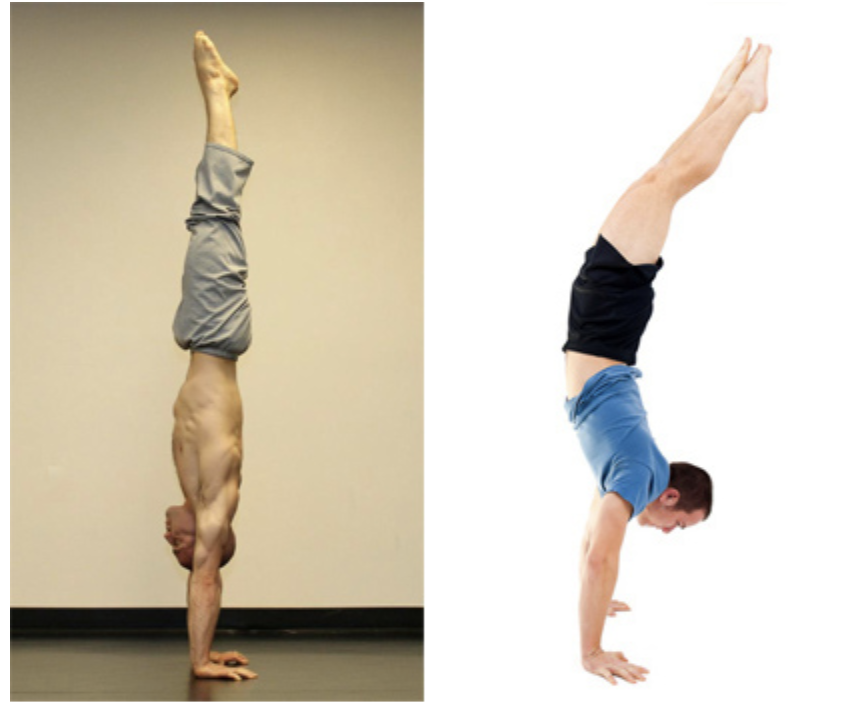
The position on the left is far easier to hold than the position on the right. Just like with stunting, with the hands, shoulders, back and legs all forming one straight line, it causes much less stress on the body. One cause for the position on the right, is lack of range of motion (ROM) in the shoulders.
Benefit 03: Improvements in Tumbling
Tumbling is all about generating and controlling momentum. One mantra will always stand true, regardless of the skill:
Better Form = Increased Control & Power
Flipping skills like handsprings (forwards & backwards) and layout all pass THROUGH the handstand position. Developing your handstand skills will teach you to control and manipulate your body so you can generate more power and control within your tumbling.
Let’s take a look at these two handstand pictures:
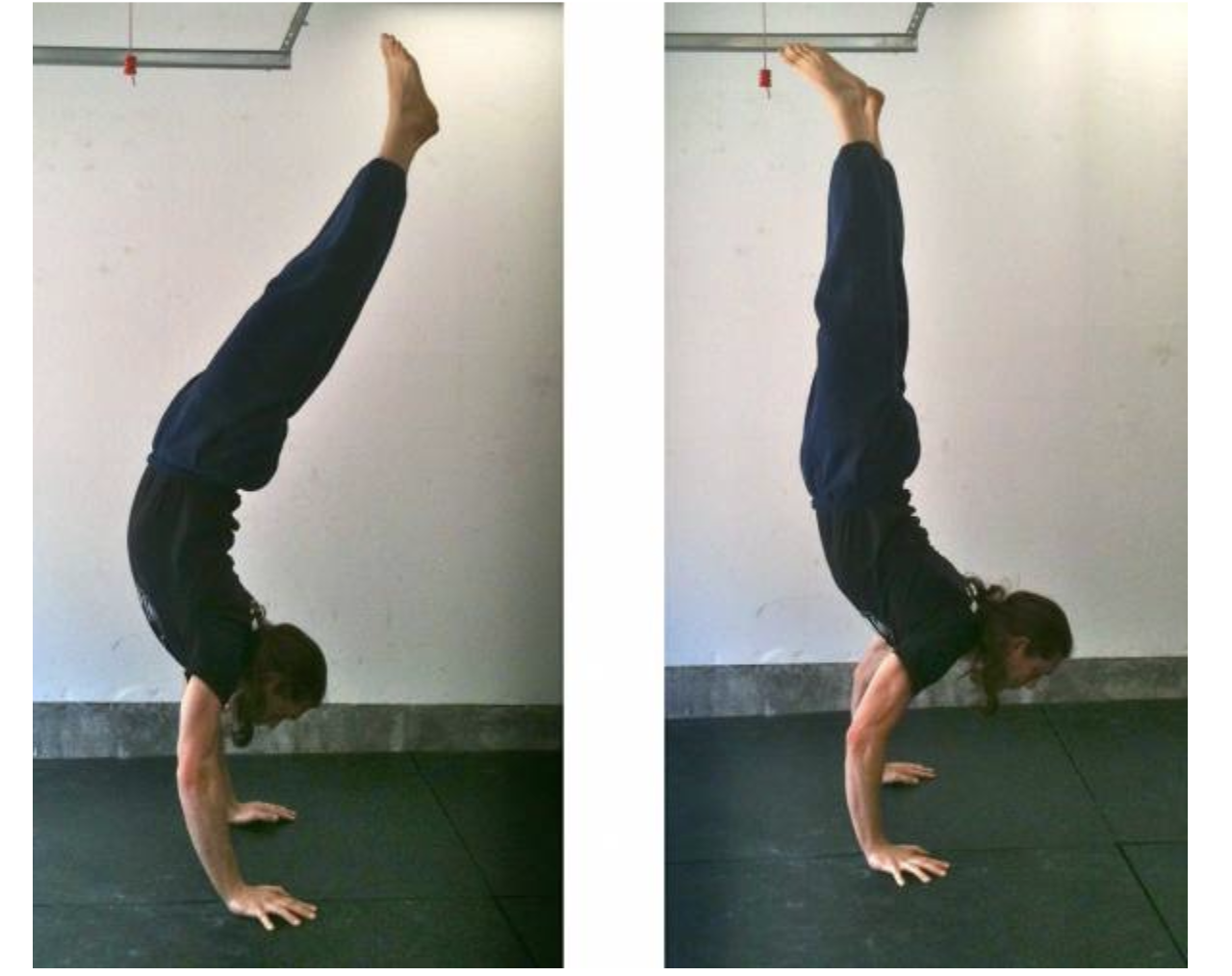
The pictures above demonstrate poor form within a handstand and these shapes directly transfer into backhandsprings (BHS). We see this a lot in athletes that are learning BHS for the first time, or have learned with poor technique. This often leads to bent arms in BHS, or even worse back head-springs.
Learning to hold to proper position in handstands works shoulder strength and range of motion, allowing you to get in the proper position during a back handspring and push through the arms and hands for better handsprings.
A BHS should pass though a tall open handstand before snapping into a hollow handstand position to complete the skill.
Benefit 04: Improved Spatial Awareness While Inverted
This is super important for anyone looking to advance their tumbling skills. Figuring out where you are in the air while upside down, based solely on how it feels is not something that comes naturally. It must be trained. Being inverted while airborne adds an extra degree of difficulty. Therefore, the more time you can spend upside down, the easier it will be to determine where you are. This is especially important for athletes learning twisting skills like layout fulls and doubles.
